An optional goal can pause when life changes. Restarting does not require pretending the missed contributions happened or doubling the next one automatically. Begin with the amount still assigned to the goal, its current price and the future dates that remain. The old schedule is background, not a debt you owe to a worksheet.
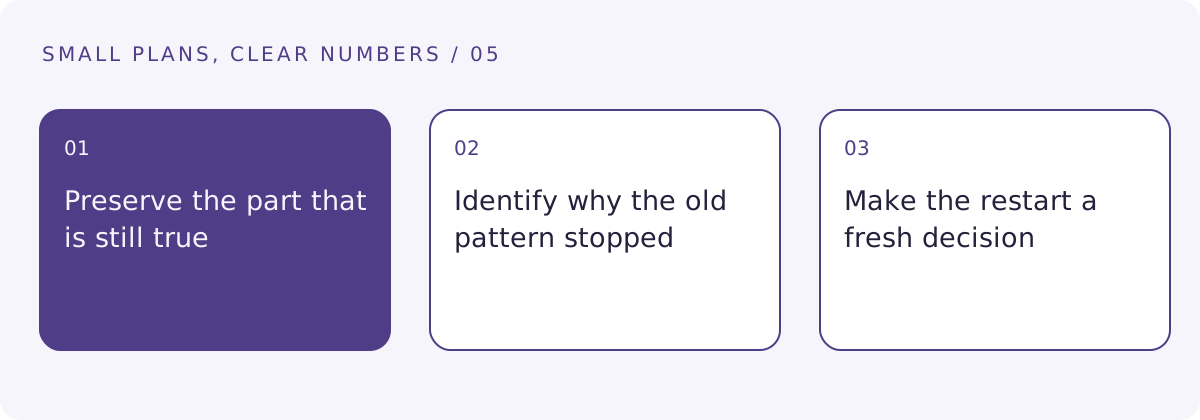
Preserve the part that is still true
Imagine an invented $360 target with $120 still earmarked. The plan paused for two contribution dates. The remaining target is still $240 if the price and earmarked amount have not changed. What changed is the time available, not the history of completed contributions.
If six future dates now remain, the simple rate is $40 per date. If only four remain, it is $60. These are arithmetic outcomes, not advice that either amount is affordable. Essential obligations and current circumstances come before the optional schedule.
Identify why the old pattern stopped
A useful reason can be practical: the goal became less important, a required expense arose or the contribution timing did not fit. You do not need to publish private financial details to learn from it. The question is which assumption should change, not who deserves blame.
A new plan might use a later date, a smaller target or a less frequent review. Avoid compensating for uncertainty with a more aggressive promise. If the underlying constraint remains, a revised spreadsheet alone will not remove it.
Make the restart a fresh decision
Check whether you still want the result. Money previously assigned to a goal does not obligate you to complete the purchase. If the goal no longer matters, decide deliberately what happens to that earmarked amount and update the record once. Do not leave it counted in both the old and new purpose.
The restart note should state the current target, current earmarked amount, remaining difference and next review point. It may conclude “stay paused.” That is a complete outcome when the information does not support a workable plan. A goal tool is useful when it reflects reality, including a decision not to continue.
Continue the comparison
A price change should update the target, not rewrite progress
Finish the goal without spending the same money twice
Method and scope
This is an original worked planning guide. All amounts, schedules and providers in its examples are fictional unless a source is explicitly identified. The calculations explain relationships, not a personalized financial recommendation. No private account or provider payment flow was tested.