A one-time amount can shorten a goal’s path, but only after it is actually assigned and still available. Do not enter it both as completed progress and as a future contribution. For readers who use Fintwist, the same principle applies regardless of where the money arrives: this site does not verify deposits or create automated savings rules.
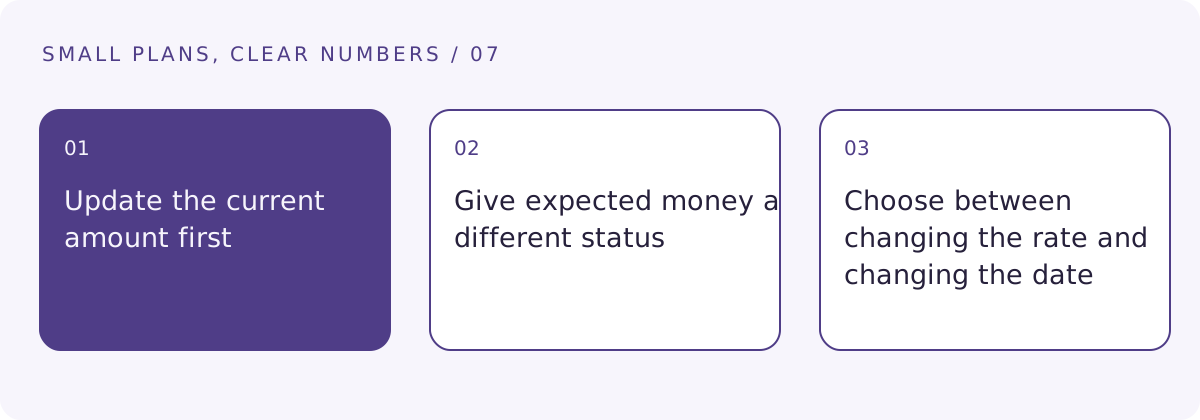
Update the current amount first
Take a fictional $500 target with $180 already earmarked. A completed one-time addition of $70 raises the current goal amount to $250 and leaves $250. If five regular contribution dates remain, the simple remaining rate is $50 per date.
A common mistake is to subtract the $70 again when calculating the remaining rate. That would produce $180 remaining, even though only $250 has been assigned toward a $500 goal. Another mistake is to leave the $70 in a separate “extra” column while adding it to the closing balance, then sum both columns later.
Give expected money a different status
A promised gift, possible refund or unconfirmed reimbursement belongs in an expectation note, not the current goal amount. Once it arrives, first decide whether it is needed for essential obligations or another purpose. Receipt does not require assigning it to this optional goal.
If only part is allocated, record that part. For an invented $100 receipt with $30 assigned to the goal, the goal increases by $30, not $100. Keep the rest out of this ledger unless its purpose is relevant to checking that no money is counted twice.
Choose between changing the rate and changing the date
A one-time addition may support a lower regular contribution or an earlier target date. It does not automatically achieve both. Calculate each alternative separately, using the same updated starting amount. A simple side-by-side example can show the tradeoff without prescribing the choice.
End with one entry for the completed addition and one revised plan. Do not schedule transfers based on this page or assume a specific provider feature exists. Our examples explain bookkeeping relationships; they do not estimate affordability, guarantee availability or recommend using money that has another necessary purpose.
Continue the comparison
Finish the goal without spending the same money twice
Count contribution dates, not vague months
Method and scope
This is an original worked planning guide. All amounts, schedules and providers in its examples are fictional unless a source is explicitly identified. The calculations explain relationships, not a personalized financial recommendation. No private account or provider payment flow was tested.