When two goals compete for the same discretionary amount, a neat pair of progress bars can conceal double-counting. Decide how a contribution will be divided before entering it in either record. This is a method for organizing choices, not a recommendation to prioritize an optional purchase over essential obligations.
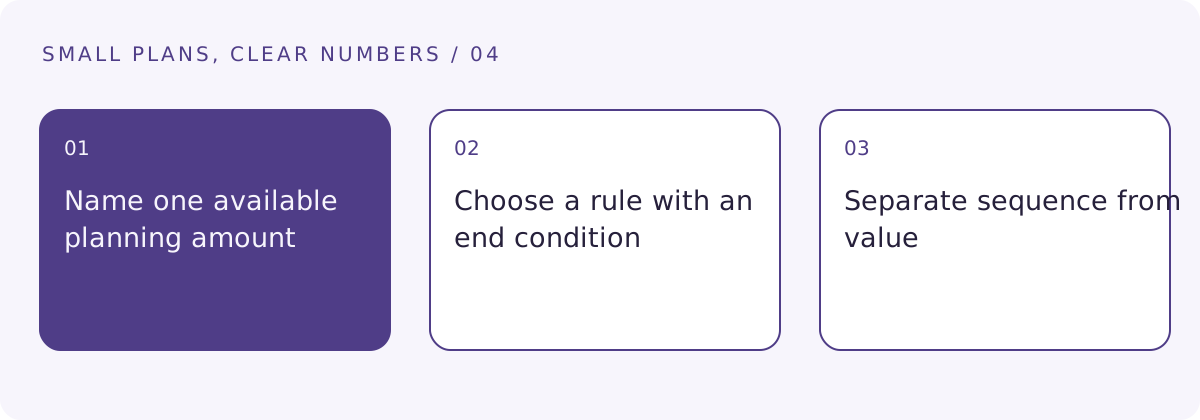
Name one available planning amount
Suppose a fictional person has chosen to consider $40 for optional goals this period after reviewing their other needs. Goal A has $120 remaining and Goal B has $200 remaining. Assigning $40 to both would record $80 of progress from $40. The error can look plausible when the goals sit in different notebooks.
An equal allocation would put $20 toward each. A temporary priority could put all $40 toward A. A deliberately chosen $30/$10 split is another possibility. Each uses the same $40 once. None is automatically fairer, safer or better without knowing the person’s circumstances and priorities.
Choose a rule with an end condition
If one goal gets priority, write when that priority will be reviewed: after a defined contribution, a date or a change in purpose. A priority that never gets reconsidered can turn the second goal into a misleading permanent promise. It is acceptable to label the second goal “paused.”
Do not make two incompatible deadlines appear achievable by changing only the chart colors. Recalculate each goal using its actual assigned share and remaining contribution opportunities. If a date no longer fits, update it visibly rather than quietly assuming extra money will appear.
Separate sequence from value
Doing one goal first does not prove it matters more as a life value. It may simply have a smaller remaining amount or a more useful timing window. Write the practical reason instead of ranking the person’s interests. A record should help a decision, not turn it into a judgment.
The finished allocation line is brief: total contribution, amount to A, amount to B and next review point. The two amounts must add to the total. This site does not connect to a card or enforce the allocation; it provides a way to keep the arithmetic consistent with the choice you actually made.
Continue the comparison
Restart from the current facts, not the old promise
Count a one-time contribution once
Method and scope
This is an original worked planning guide. All amounts, schedules and providers in its examples are fictional unless a source is explicitly identified. The calculations explain relationships, not a personalized financial recommendation. No private account or provider payment flow was tested.