A useful goal names a result and the costs included in reaching it. “Save for a hobby” is an intention; “set aside enough for one $240 workshop and its required $30 materials” is a defined target. This publication is for adults considering an optional one-time goal after essential obligations, including readers paid through Fintwist. It does not recommend a savings account or move money.
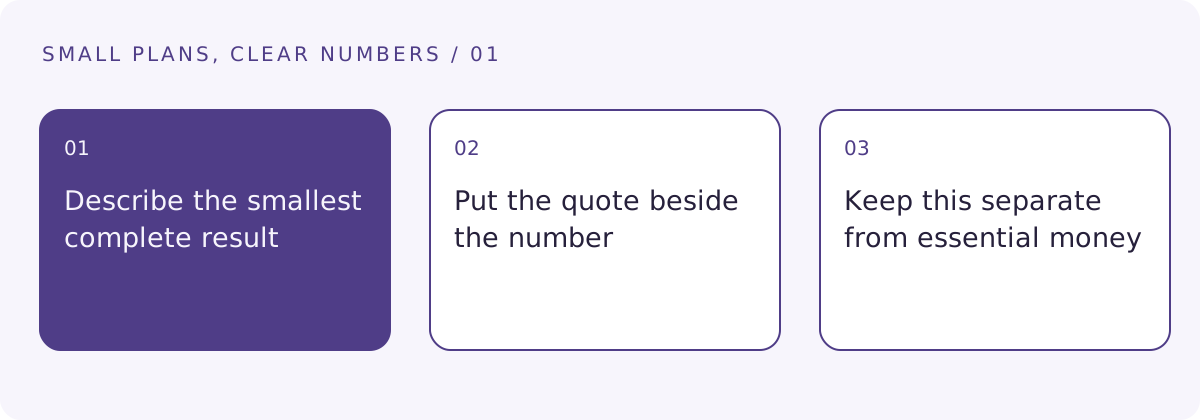
Describe the smallest complete result
Write what the goal includes and excludes. A purchase price might omit delivery, required equipment or an applicable fee. Conversely, an optional upgrade need not be part of the minimum result. A larger number is not automatically more responsible if it includes things you do not want.
For the fictional workshop, $240 plus $30 gives a $270 known target. An optional $40 book is a separate choice. If transport has not been priced, the target is incomplete for a person who needs to travel. “Unknown” is a better label than silently entering zero.
Put the quote beside the number
Record where the amount came from and when it was checked. A current quote, an old receipt and a rough estimate have different levels of certainty. If a price expires before the goal date, plan to check again. A budget line does not reserve a place or lock a merchant’s price.
Decide what change would reopen the plan: a different item, a price increase or a new requirement. This prevents every attractive addition from quietly becoming part of the original commitment. The target is a decision boundary, not permission to spend any amount associated with the same hobby.
Keep this separate from essential money
A goal record should not count money already assigned to necessary bills, food, housing or another obligation. We do not know your circumstances and cannot determine a safe contribution for you. Pausing an optional goal can be a sensible decision; the worksheet is not a test of discipline.
The finished output is a sentence: “My defined goal is this result, with these included costs, totaling this amount as of this date.” No account identifiers are needed. A clear sentence makes later arithmetic meaningful because everyone is calculating toward the same result.
Continue the comparison
Count contribution dates, not vague months
Two optional goals need an allocation rule
Method and scope
This is an original worked planning guide. All amounts, schedules and providers in its examples are fictional unless a source is explicitly identified. The calculations explain relationships, not a personalized financial recommendation. No private account or provider payment flow was tested.