A goal ledger answers “How much is currently assigned to this goal?” An available card balance answers a different account question. A Fintwist card may hold money needed for several purposes; writing a goal number does not create a protected savings compartment or change the account’s features.
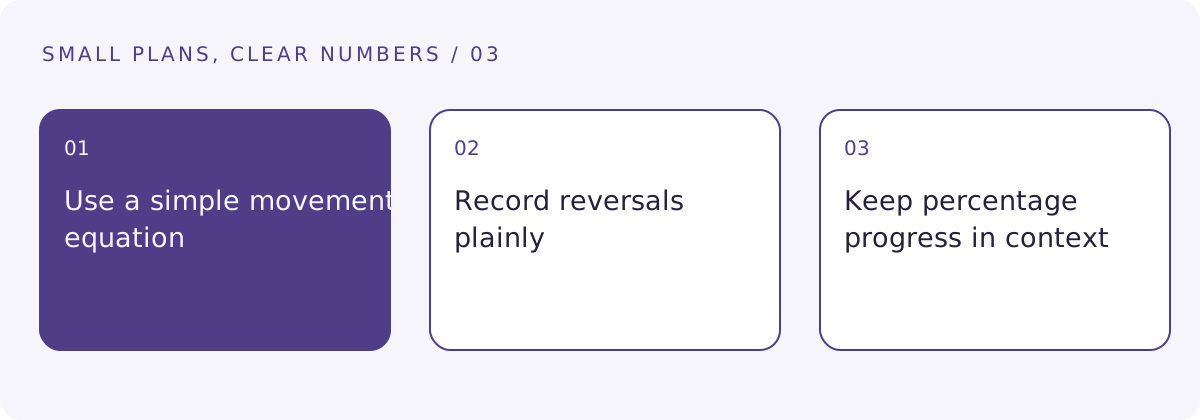
Use a simple movement equation
Start with the last verified goal amount. Add contributions actually assigned since then. Subtract amounts actually removed from that goal. The result is the updated earmarked amount. Keep a contribution plan in a separate column so that intention does not appear as completed progress.
In an invented example, the goal begins with $80. A completed $25 contribution and a $10 withdrawal for another purpose produce $95. A planned $20 contribution next week does not make the current amount $115. If the target is $250, $155 remains under these assumptions.
Record reversals plainly
If a contribution was entered by mistake, correct the record with a note rather than adding another positive entry. If money was reassigned to an essential need, show the change without treating it as moral failure. The purpose is an accurate current picture, not an unbroken upward line.
A ledger is only as reliable as its connection to actual money. Periodically check that the amount marked for the goal has not also been promised elsewhere. Do that privately through the appropriate account records. This website does not request balances, credentials, transaction histories or screenshots.
Keep percentage progress in context
For a $250 target, $95 is 38 percent. That percentage describes the defined goal, not financial well-being, creditworthiness or how close someone is to meeting essential needs. If the target price changes, the percentage changes even when the saved amount does not.
A useful progress note states the date, opening amount, completed additions, removals and closing amount. It also lists any unresolved mismatch. Do not force the record to agree by inventing a contribution. Resolve the discrepancy before relying on the number for an optional purchase.
Continue the comparison
Two optional goals need an allocation rule
A price change should update the target, not rewrite progress
Method and scope
This is an original worked planning guide. All amounts, schedules and providers in its examples are fictional unless a source is explicitly identified. The calculations explain relationships, not a personalized financial recommendation. No private account or provider payment flow was tested.