Reaching a target amount completes a planning milestone, not the purchase itself. Before using earmarked money, check the current price and whether you still want the result. A goal record cannot reserve availability, create a merchant agreement or guarantee that a payment method will be accepted.
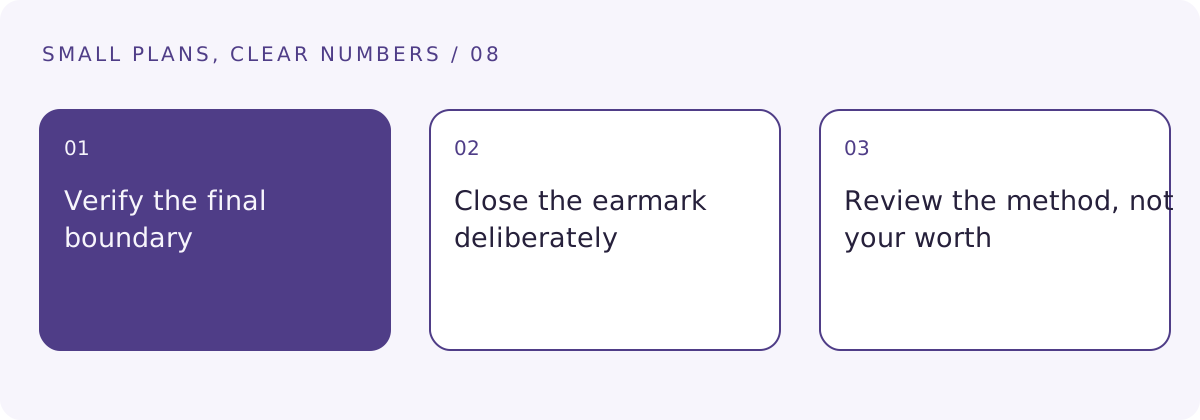
Verify the final boundary
Compare the current offer with the result originally defined. Confirm the required total, applicable fees, delivery or service conditions and cancellation terms. If the amount has changed, update the plan before committing. Do not treat an old target as evidence that the current transaction is affordable.
In an invented example, $280 has been earmarked for a purchase that now totals $265. Completing the purchase uses $265 and leaves $15 unassigned within the former goal. It does not leave $280 “saved” plus a purchased item. The ledger needs to show the use of the money.
Close the earmark deliberately
Record the actual amount used and decide what happens to any remainder. If the purchase is abandoned, release or reassign the earmark once. A new goal can receive the remainder, but the old goal must no longer count the same amount as available.
A receipt serves a different purpose from the goal ledger. Keep whatever is needed for the merchant relationship, warranty or other legitimate requirement, without collecting unnecessary private records. This site does not provide a document vault or ask you to upload proof of purchase.
Review the method, not your worth
Ask which assumption was most useful to correct: target scope, timing, a price revision or a missed contribution. Keep one practical lesson for the next optional goal. There is no need to turn the process into a score or a public statement about financial success.
If you decide not to buy, that can still be a successful decision. The purpose of planning was to preserve choice, not force spending at the finish line. For account-specific questions, use verified provider resources. For this publication’s examples, the result is a clear record of what was planned, what happened and what remains available for another purpose.
Continue the comparison
Give one optional goal a complete price boundary
Measure progress without confusing it with a card balance
Method and scope
This is an original worked planning guide. All amounts, schedules and providers in its examples are fictional unless a source is explicitly identified. The calculations explain relationships, not a personalized financial recommendation. No private account or provider payment flow was tested.